


Living with Type 1 Diabetes: How a Hybrid Closed-Loop System Gave Me Back My Freedom
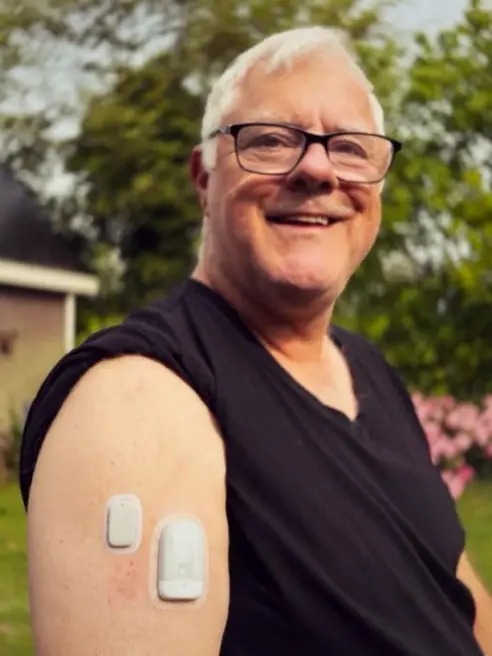
Norbert Stellaard wearing the Medtrum Nano 300U patch pump and CGM sensor
Living with diabetes means constantly thinking about your blood glucose levels throughout the day. How many carbs are in this meal? Will I be more active than usual today or less? Am I about to exercise, or go for a long walk later?
These are just a few of the questions running quietly in the background all day long. And that doesn’t even include factors like illness or stress, both of which have a major impact on glucose levels and, ultimately, on your quality of life when living with diabetes.
From Glass Syringes to Insulin Pens: My Early Journey
I was diagnosed with Type 1 diabetes at age 15, back in 1985. I still remember thinking: there goes my future. At the time, I was competing at a national youth level in archery in the Netherlands. I trained six days a week. Together with my personal coach, I followed a strict training program designed to improve step by step.
But when I was diagnosed, everything changed.
At first, I resisted my “new life” completely. Injecting myself felt frightening, and I often avoided it whenever I could. In 1985, there were very few treatment options available. We used glass vials filled with pork insulin and glass syringes that you had to fill yourself before injecting. Looking back now, I realize how sensitive that process was to mistakes and how serious the consequences could be.
Soon after, pen therapy was introduced. These early insulin pens were large and required inserting a separate cartridge and plunger, but they represented a major step forward compared to loose syringes and vials. Suddenly, everything was contained in one device. Attach the needle, dial the number of units, and inject. The risk of dosing errors dropped significantly.
Pork insulin was eventually replaced by synthetic insulin. Concentrations increased from 40 units per milliliter to 100 units per milliliter, allowing for more precise dosing and smaller injection volumes. Technology continued to improve gradually.
Long-acting insulin also evolved. Its role is to provide a steady baseline insulin level throughout the day, and over time its release profile became more stable and predictable, with fewer peaks after injection.
The Limitations of Traditional Pumps and Sensors
Still, even as technology improved, carbohydrate counting, activity levels, stress, and illness remained major factors in diabetes management. Every day involved constant calculations. Afterward, finger-stick testing was needed to confirm whether the estimated insulin dose had been correct. Running too high meant slowly damaging your body. Tiny blood vessels especially in the eyes could become blocked or rupture, potentially leading to blindness over time.
Then insulin pumps entered the market. Using an infusion set, a small needle was inserted under the skin and connected to a pump worn in your pocket. If you went swimming or visited the sauna, you had to disconnect it. You still had to calculate insulin needs manually and deliver doses using a bolus through the pump or an app.
For me personally, as someone who regularly spends full days at the sauna, this solution wasn’t practical. Disconnecting a pump for extended periods simply wasn’t realistic.
Blood glucose monitoring technology also evolved dramatically. We moved from finger-stick testing to wearable sensors placed directly on the skin. A tiny filament sits just under the surface, measuring glucose levels in interstitial fluid and sending updates every few minutes to a reader or smartphone.
It’s important for users to understand that these sensors don’t measure blood glucose directly. Instead, they measure glucose in tissue fluid and calculate an estimated blood glucose value. Typically, readings lag about five minutes behind actual blood glucose levels. Even so, this technology made living with diabetes significantly easier.
When Alarms Aren’t Enough: Facing New Complications
Over the years, I experienced every stage of this evolution. I went from being a teenager who strongly resisted having diabetes and struggled with high HbA1c levels to becoming what you might call an experienced diabetes self-manager. My job took me all over the world, and continuous glucose sensors connected to my phone helped keep me safe even when traveling alone in unfamiliar countries. If I experienced nighttime hypoglycemia, alarms from the app would wake me up.
Last year, things changed. I stopped feeling my hypoglycemia episodes. The alarms became essential not just at night, but during the day as well.
Even after all these years, I was still using pen therapy: four injections per day, one long-acting insulin dose and short-acting insulin with each meal. Despite doing everything possible to stay between 4 and 10 mmol/L, my HbA1c remained around 47–51 mmol/mol, and my time in range fluctuated significantly. Meanwhile, early signs of retinopathy began to appear in my eyes, the first visible complications of diabetes.
My diabetes nurse told me about a new product expected to enter the market: a patch pump combined with a continuous glucose sensor that communicates directly with the pump. A Hybrid Closed Loop (HCL) system.
Even more impressive, the pump includes AI-driven algorithms that continuously adapt to your body, lifestyle, and insulin needs. Manual carbohydrate calculations become unnecessary.
Instead, you simply indicate whether you’re eating breakfast, lunch, dinner, or a snack, or whether you’re about to exercise. The system handles the rest.
Life-Changing Results: Embracing True Freedom
I’ve now been using the Medtrum Nano 300U patch pump together with the CGM sensor for about nine months, and honestly, it’s been life-changing.
● No more carb counting.
● No more constant adjustments.
● Just indicate what I’m doing, and the system takes care of nearly everything automatically.
My time in range is now around 75%, and my HbA1c has improved to 42 mmol/mol, which is comparable to levels seen in people without diabetes. And my retinopathy? It has stabilized and is no longer progressing.
I can enjoy my bath time. I walk frequently. And I can confidently say that using the Medtrum pump and sensor Hybrid Closed Loop solution has given me something I hadn’t experienced in decades:
Freedom.
No more constant carb counting. No more large glucose swings. Just stability. Confidence. And freedom.
And that is exactly what I want.
Thank you Medtrum Tech for make my life more easy.
